Development of Multiple good Habits
When you’re trying to break bad habits, you need to resist. But with good habits, you need to remind.
Mark the calendar. Set the alarm. Use a checklist.

Hang out with pals who have the habit you want. Across many different kinds of behavior (voting, smoking, weight loss and weight gain, happiness, etc), people are very meaningfully affected by the behaviors of other people to whom they’re connected.
Peer pressure works. And a good support network shows us that change is possible.

Abdominal Exercise | Vacuum Twists
How to Begin Again With a Change in Mindset
And how about the way you feel when you’re actually in the midst of something new? All of your senses are on high alert as you enter a different environment. You may feel hesitation as you navigate through a situation.

Adopting a beginner’s mindset can be just as useful when you’re in a familiar environment. You may think you know everything there is to know about a topic, but then something unexpected pops up.
No matter how much you already know, you still have a lot more to learn. This is where the “Empty your cup” mindset becomes useful. Like a cup, your mind needs to be emptied before it is ready for more.

Your mind needs to get rid of its old preconceptions to make room for learning, growth, and ideas. How can you learn when you believe you already know? How can you grow when you think you’ve reached the end?
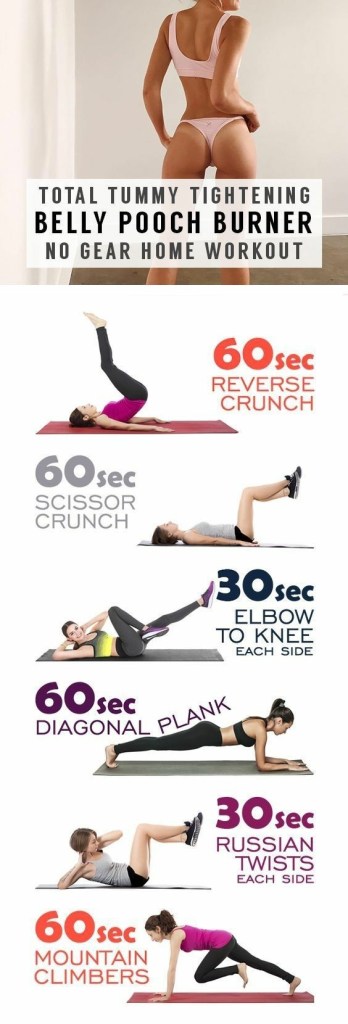
Belly Pooch Burner
Take Care of Your Diet
The lockdown has increased the sales of chips, popcorn, and processed food, while fresh produce (fruits and veggies) are rotting.

Restricting high-calorie and sugary foods from your diet, while ensuring you don’t eat all day is the key to lose weight and gain energy. It would also be great to eat lots of green vegetables.

6 Min Core Workout to Get Flat Abs | Follow Along | ARICA SKY
New Beginnings
When you begin, all the doors are open. Infinite possibilities lie ahead. Your future is a blank slate, yet to be written.
Nervousness mixes in with excitement. You feel unfamiliarity, uncertainty, maybe even fear. These emotions combine to create a rush, a thrill from being someplace new.
We usually assume that experts are superior to novices, since they know better. And that’s usually true. But in some unexpected ways, a beginner can have hidden advantages over an expert.
As a beginner, you don’t have preconceived notions about what is and what isn’t, what’s possible and what’s impossible. You don’t know the limits, you don’t know the rules.
Everyone who’s been somewhere awhile knows how things are “supposed” to be. They know what they can and cannot do. Their beliefs are set in stone, hardened by what they’ve experienced.
This is why being a beginner can be a hidden advantage. You see and approach problems differently, so you come up with solutions that others may not have considered. You shake up the norms and force people to rethink current strategies.
According to research, taking on new challenges also leads to actual changes in the brain. By trying new things, your brain forms new neural connections. In the process, your thinking skills improve and you fend off cognitive decline.

Do This Everyday To Lose Weight | 2 Weeks Shred Challenge

 Studio-7-West